


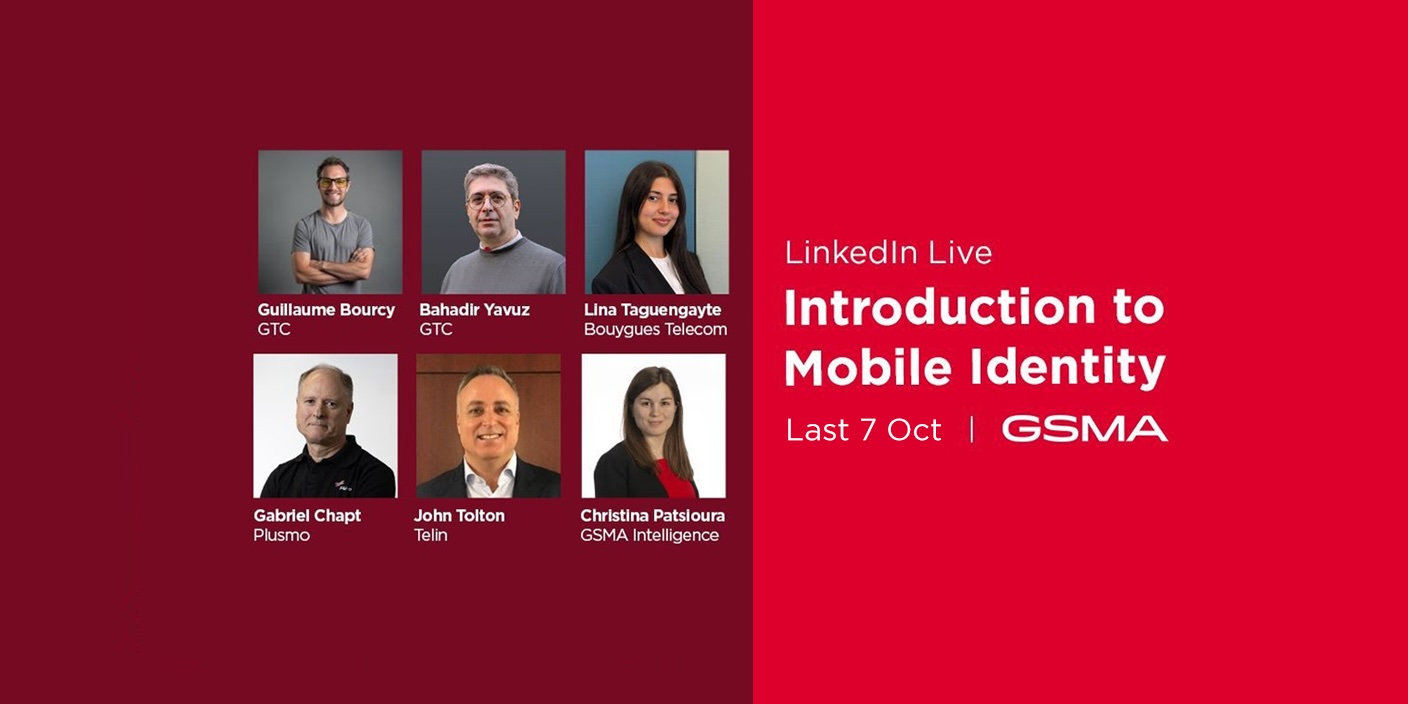
On Tuesday, October 7, we had the privilege of participating in a live session on “Introduction to Mobile Identity”, organized by GSMA. The event showcased practical use cases from different parts of the world, and our CEO, Gabriel Chapt, presented implementations carried out by Plusmo in both Argentina and France.
At a time when mobile fraud, data breaches, and scams are intensifying, and when the use of artificial intelligence (AI) to scale cybercrime is becoming evident, there is an urgent need for advanced authentication solutions that not only address regulatory demands but also support the acceleration of digital transformation.The market is beginning to recognize the enormous potential of the mobile phone number as a “magic bridge” between users’ physical and digital identities.
As Helene Vigue, Identity and Data Director at GSMA, pointed out: “Today, mobile networks have real ‘superpowers’ that allow enterprises to harness the benefits of mobile identity, enabling more secure authentication with minimal friction.Verification is now possible through network APIs made available by multiple operators and networks”.
Why Mobile ID is advancing
Mobile identity services are gaining traction as companies struggle with traditional verification methods which are becoming less sustainable. “Silent verification of the phone number is a strong replacement for OTPs, since it provides convenience and ensures rapid adoption. But beyond replacing OTPs, it allows the entire ecosystem to trust a standard that leverages multiple data points throughout the user’s digital journey”, said Guillaume Bourcy, Partner & ChiefIdentity Officer at Global Telco Consult.
He illustrated this with a growing demand: “There is a rising need to verify individuals’ ages across many countries, not only due to government requirements, but also from companies such as social networks, fintechs, and gaming platforms that require a solution.For this, Mobile ID is ideal. In other words, mobile identity is not just about logging in or authenticating as a replacement for OTPs—it has a wide range of applications and multiple use cases.”
Positive Experiences
Worldwide, many companies are already benefitting from mobile identity through network APIs developed by operators and their partners. In this context, Gabriel Chapt shared the case of the digital wallet Movipay in Argentina, which improved its protection against SIM swap fraud in its payment service: “The company implemented the SIMSwap API in March 2024 to reduce the growing number of chargebacks. Previously, password recovery was managed via SMS or email using OTPs. Since implementing the API, if a SIM swap attempt occurs, the password recovery process is blocked, and the user is directed to the call center for personal verification.As a result, chargebacks were reduced by an impressive 80%”.
Chapt also shared the case of Younited, a microcredit company operating in France,Spain, and Italy: “The company’s main problem was fraudulent brokers applying for loans while impersonating victims, using public information or phishing tactics. By implementing the KYC Match and SIM Swap APIs, Younited achieved remarkable results: a 70% reduction in fraud-related losses. In addition, 0.5%of total loan applications were blocked due to suspicious SIM swap activities”.
Similarly, John Tolton, SVPGroup Strategy, Sales and Enablement at Telin, highlighted his company’s experience implementing mobile identity solutions with hyper scalers inIndonesia: “Mobile ID APIs are solving many problems linked to fraud, phishing, and AI-driven scams. They also deliver a far smoother user experience. In fact, the process is so seamless that many customers—used to the old system—even ask whether they are truly being authenticated, because the verification requires no effort on their part”.
To access the full recorded session, click here.